The international classical music channel, in 4K Ultra HD and spatial sound. Leave your email and we will personally let you know as soon as Allegro Spatial is available where you live.
One email when we arrive where you live. Nothing else.
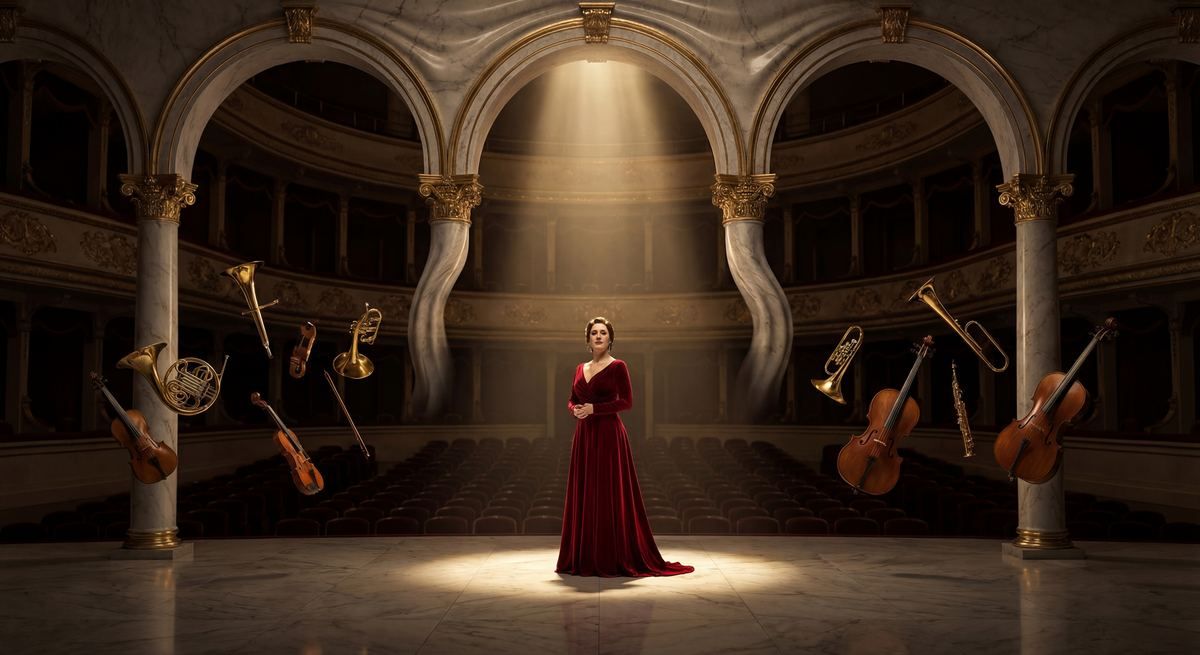
La sonnambula (The Sleepwalker) is an opera in two acts by Vincenzo Bellini, first performed at the Teatro Carcano in Milan on 6 March 1831, to a libretto by Felice Romani. It tells the story of Amina, a young woman in a Swiss village whose sleepwalking leads her, asleep, into the bedroom of a stranger, putting her marriage to Elvino at risk. It is one of the peaks of bel canto and contains the aria "Ah! non credea mirarti".
Act I. A village in the Swiss Alps is celebrating the betrothal of Amina, an orphan raised by the mill owner Teresa, to the prosperous farmer Elvino. Lisa, the innkeeper, loves Elvino and watches the festivities with resentment. An elegant stranger arrives: he is Rodolfo, the local count, returning incognito after many years. That night, at the inn, Amina walks in her sleep into the count's room and falls asleep on his sofa. Discovered there by the whole village, she is accused of infidelity. Elvino, beside himself, breaks off the engagement.
Act II. The villagers go to the castle to ask the count for an explanation. He insists that Amina is innocent and explains the phenomenon of sleepwalking, without convincing Elvino, who resolves to marry Lisa. Then Amina appears, walking asleep across the mill roof, a perilous crossing, before the whole village. In her dream she mourns the loss of Elvino and sings "Ah! non credea mirarti". The proof of her innocence moves everyone; Elvino returns her ring and Amina wakes amid general rejoicing, which she crowns with the rondo "Ah! non giunge".
Bellini composed La sonnambula at the beginning of 1831 for the Teatro Carcano in Milan, in close collaboration with Felice Romani, his regular librettist. The subject comes from a French ballet-pantomime about a sleepwalker, a fashionable motif at the time. Unlike the tragedies that dominated the stage, the work belongs to the semiseria genre: a sentimental drama in a village setting with a happy ending.
The premiere brought together two legends of singing: the soprano Giuditta Pasta as Amina and the tenor Giovanni Battista Rubini as Elvino. The success was immediate and lasting. In the same year, 1831, Bellini also brought out Norma: two landmark works within a matter of months.
La sonnambula is a summary of Bellini's art: long melodies, expressive ornament and a discreet orchestra that supports the voice. Amina introduces herself with "Come per me sereno", and her final sleepwalking scene, "Ah! non credea mirarti" followed by the brilliant "Ah! non giunge", is among the most admired scenes in the soprano repertoire. Chopin is said to have revered this music, whose echo can be heard in his nocturnes.
The role of Elvino, written for Rubini, demands a tenor of exceptional high notes and elegant phrasing. Great sopranos of the twentieth century, from Maria Callas to Joan Sutherland, made Amina one of their signature roles and brought the work back to the centre of the repertoire.
Behind its simple plot, La sonnambula offers something few operas give: an hour and a half of pure melody, in which all the drama passes through the voice. Amina's final scene, suspended between dream and sorrow, keeps its power to move intact, and the role remains a touchstone for the sopranos of today.
Allegro Spatial is not yet available in your country. Leave your details on our home page and be the first to know when the channel reaches your screen.